
In the past six months, the AI landscape has undergone a significant transformation: it is no longer just about writing a few lines of code but is now attempting to take over the entire development process, from requirement breakdown and architecture design to coding and bug fixing. The evaluation of AI programming tools has shifted from how much code they can write and its quality to whether they can complete tasks efficiently and reliably.
However, many developers find that as AI becomes more powerful, the task of writing projects does not necessarily become easier; in some cases, it has even become more complex.

Claude Code Routines: A Game Changer
At 3 AM on April 15, many developers were awakened by notifications from Anthropic about the epic overhaul of Claude Code, introducing the new Routines automation feature and a complete desktop redesign. This upgrade has significantly raised the bar for AI programming. Previously, automating tasks with AI required developers to set up cron jobs, maintain servers, and configure complex MCP connectors, which posed a high barrier to entry. The new Routines feature moves all this to Anthropic’s cloud.
In simple terms, developers only need to package prompts, code libraries, and commonly used external tools (like GitHub and Linear), set trigger conditions—whether time-based, API-triggered, or responding to new GitHub events—and Claude Code can operate independently in the cloud. Even if you shut down your computer or go offline, it can still perform tasks according to the established workflow: automatically pulling the highest priority bugs at 2 AM, fixing them, and preparing pull requests for review in the morning; automatically reviewing new pull requests according to team standards; and even regularly scanning the codebase, updating documentation, and cleaning up issues, truly achieving year-round operation.
The redesigned desktop version has also addressed previous experience shortcomings. Now, multiple Claude sessions can run side by side in the same window, managed through a new sidebar, eliminating the need to switch windows frequently. The built-in terminal, native file editor, and revamped diff viewer allow for direct previews of HTML and PDF files, with a layout that supports drag-and-drop, rivaling professional IDEs. Objectively, after this overhaul, Claude Code’s position as a leading AI programming tool is more secure—it is no longer just a code completion tool but a cloud-based collaborative partner capable of independent operation.


Challenges for Developers in China
However, the stronger the features, the more difficult it is for developers, as these capabilities are still inconvenient to use in China. According to the latest updates on Anthropic’s official support page, the platform has introduced a verification mechanism supported by third-party identity verification service Persona. When users subscribe to specific high-tier plans like Claude Max or trigger key operations, the system mandates real-name verification. This KYC requirement has made the already challenging subscription process even more difficult for domestic developers.

The core requirements are quite strict:
- Accepted Types: Government-issued photo ID, including passports, driver’s licenses, and national ID cards.
- Hard Conditions: Must possess the physical original; photocopies, screenshots, scans, and photos of the ID are invalid.
- Real-Time Verification: Requires a live selfie taken with a mobile or computer camera to compare with the ID photo.
While Silicon Valley celebrates the 24/7 operation of AI Routines, developers in China are troubled by the need for an “overseas physical ID.” The issue is not about coding skills but rather the “entry barriers.”
Recently, an engineer from the AtomGit community, Xiao Wu, opened Claude Code as usual for work but found his account suspended again, interrupting his progress. He has faced account bans four times, each requiring him to re-register, reconfigure, and reconnect, which has been frustrating.
Of course, he is not alone. Tools like Claude Code and Cursor have become indispensable for many developers. Claude Code is particularly recognized for its capabilities in complex logic breakdown and long-context code refactoring. However, the reality of high costs and network issues keeps many developers stuck in place.
Even if you manage to complete identity verification, costs and network issues remain significant hurdles:
- Cursor Pro Subscription Fee: Up to $20/month (approximately 140 RMB), with heavy usage leading to rapid quota depletion, easily exceeding $100/month for complex projects. Claude Code’s token-based billing can lead to unexpected cost increases of 10-20 times due to cache expiration and other technical issues, with normal usage of Claude Opus 4.5 exhausting tokens in less than two days.
- Unstable Network: Due to compliance requirements, direct access is not possible in China, leading to frequent risk control triggers.
- Uncontrollable Account Suspension Risks: Abnormal IP ownership, large amounts of recharge in a short time, and multi-node logins can be flagged as high-risk, leading to unexpected account bans even for compliant heavy users, interrupting all prior investments.
- Limited Usage Quotas: Even paid users often face situations where their quotas are exhausted prematurely, with Pro users reporting only 12 days of usable service in 30 days, severely hindering development progress.
Some joke that they spend half their time coding and the other half troubleshooting tool issues, caught in a cycle of account bans and recharges. It raises the question: is there anyone who has never been banned by Claude? How did you manage that?

A New Direction
Xiao Wu and his two friends did not rush to find alternative tools but instead reviewed the core needs of developers: what they truly need is not a “stronger model” but a stable, cost-effective AI programming assistant without entry barriers—it cannot have a monthly fee exceeding hundreds of dollars, cannot rely entirely on VPN nodes, and must not have unexpected account bans, allowing developers to complete full engineering tasks.
Thus, they made an engineer’s choice: instead of relying on a single model’s capabilities, they developed a lightweight engineering system that allows ordinary models to complete full engineering workflows stably while avoiding account bans, high costs, and network restrictions.
AtomCode was born. If Claude Code represents the upper limit of AI programming, AtomCode focuses on whether ordinary developers can use it.

The First Prototype: A Three-Person Team and Three Nights
The earliest version of AtomCode started with a simple goal: adapting to mainstream domestic open-source models (DeepSeek, Qwen, Zhiyu, etc.) that do not require VPNs or paid subscriptions, allowing local deployment to solve issues of account bans, unstable networks, and high costs from the root. Based on this, they began to reconstruct the engineering execution logic, focusing on three core tasks:
-
Building a Controllable Execution Workflow: This evolved into a stable execution layer based on Rust. The design goal was not speed but to ensure that each step is executable, traceable, and recoverable. They realized that the real pain point in AI programming is not “writing errors” but “process interruptions”—like when using Claude Code, where tasks often get stuck halfway or steps break down. This execution workflow aims to ensure every development step is traceable, allowing for quick recovery from exceptions without disrupting overall progress.
-
Task Breakdown and Automatic Correction Mechanism: Instead of letting the model “freely play,” complex projects are broken down into manageable tasks. After each step, the system automatically verifies results and corrects errors, ensuring that context semantics are preserved and steps remain connected. This way, even using a less capable ordinary model can still complete the entire engineering process without manual corrections.
-
Absorbing Complexity into the System: They reached a consensus that users should not have to adapt to the model or solve tool usage issues. Thus, much of the engineering complexity is absorbed into the system—whether it’s model adaptation, workflow control, or local deployment configuration, all handled automatically by the system. Users only need to focus on development goals without worrying about technical details, allowing even novice developers to get started with a single click.
This initial prototype was not perfect, but it achieved a key breakthrough: it allowed a model that is not top-tier to complete an entire engineering workflow.
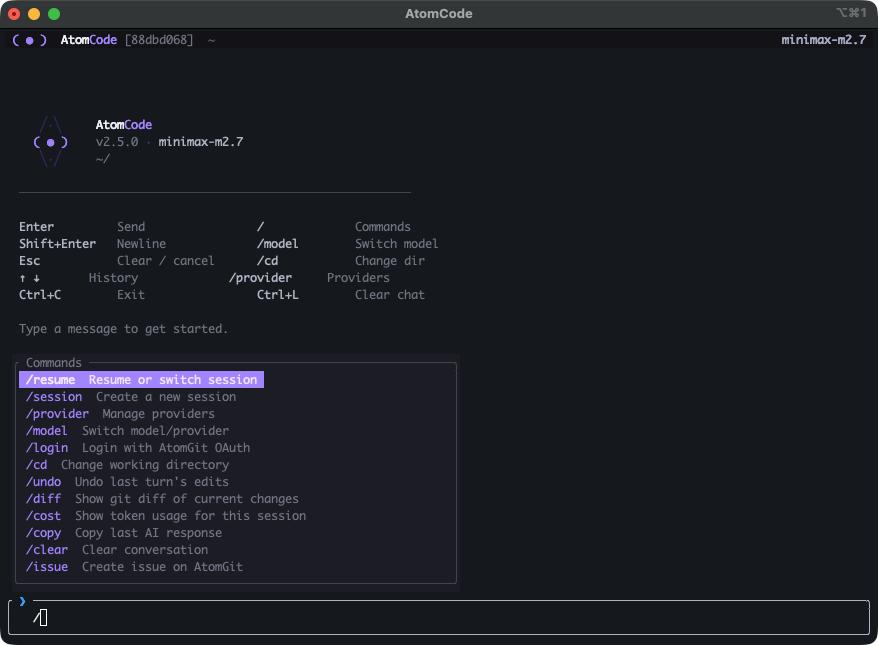

A More Thorough Decision: Open Sourcing AtomCode on April 18
This initiative is not to showcase capabilities or attract traffic but to publicly validate whether this approach—“enabling models to truly complete engineering tasks and allowing ordinary developers to use them without barriers”—is universally applicable. Can it be replicated in more scenarios and by more developers? Can it truly change the current predicament of AI programming tools?
They hope to gather more developers’ strength through open-sourcing to optimize the system and improve functionality, making AtomCode more stable and powerful. They also aspire to provide domestic developers with a set of AI programming solutions tailored to local scenarios—no VPNs, no fees, no account bans, allowing users to complete complex engineering tasks with ordinary devices and models with just a click.
- Complete Source Code Open: AtomGit/GitHub dual-platform synchronization, free to fork, modify, and co-build.
- All-Platform Installation Package: Windows/Mac/Linux + Docker, one-click local deployment.
- Local Automation Like Routines: Free, unlimited, and data secure.
- Offline Developer Day + Online Live Broadcast: Technical team deep dives, public roadmap, interactive Q&A. The event will demonstrate how to stably complete complex engineering tasks, break free from reliance on strong models and high computing power, maintain coherent multi-step execution workflows, and achieve one-click local deployment without VPNs or complex configurations, making it accessible for beginners.
The community will also invite mainstream model vendors, core developers, tech bloggers, and open-source project authors to discuss a critical industry question: Who should define the boundaries of AI programming? Is it about chasing stronger models or building better systems? Should it serve a few elite developers or be accessible to every creator?

Conclusion
If the past year has seen the industry chasing stronger models, AtomCode aims to carve out a different path: even when models are not strong enough, the system’s capabilities can still complete and enhance engineering tasks.
On April 18, join every believer in engineering power and every open-source enthusiast to witness the official launch of AtomCode, reconstructing another path for AI programming, truly returning AI programming to its engineering roots and benefiting every creator.
Hardcore developers are invited to participate in refining a genuinely engineering-grade AI coding tool.
Now, sign up to become one of the first beta testers to unlock:
- Priority Experience of Version 0.1
- Exclusive High-Performance Computing Support
- Limited Edition ‘Cyber Geek’ Customized Merchandise
Want to be the first to experience it? Add Code Master and note “AtomCode Tester.”

Prize for Comments
Share your funny experiences of being banned by Claude/Cursor in the comments; the most ’tragic’ story will win AtomGit customized merchandise.
Comments
Discussion is powered by Giscus (GitHub Discussions). Add
repo,repoID,category, andcategoryIDunder[params.comments.giscus]inhugo.tomlusing the values from the Giscus setup tool.