Introduction
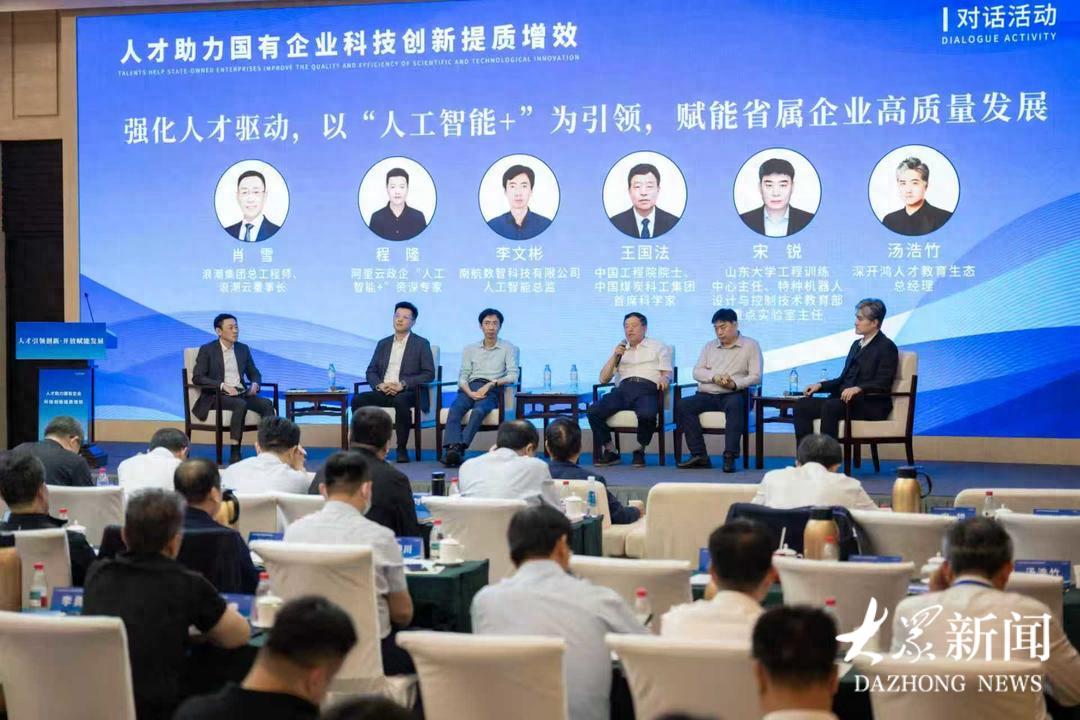
On May 13, a dialogue event focusing on how talent can enhance technological innovation in state-owned enterprises was held in Jinan. Representatives from various sectors, including industry, higher education, and technology companies, gathered to discuss the deepening reality of the “AI+” initiative. A clear consensus emerged: artificial intelligence is not merely a tool but a systematic revolution concerning management paradigms and organizational forms.
The Core Variable: Talent
In this revolution, talent is the core variable. Xiao Xue, Chief Engineer of Inspur Group, posed a critical question to the attendees: what kind of talent do we need to support this grand intelligent transformation?
In the operational practices of DeepOpen, the answer points to three key types of talent: engineering talent, composite talent, and ecological talent. Tang Haozhu, General Manager of the Talent Education Ecosystem at DeepOpen, noted that all enterprises currently face a shortage of these three types of talent. Engineering talent serves as the foundation for technology transformation; they must understand algorithms and system architecture and be able to convert code into deployable products. Composite talent acts as a bridge for practical applications; they are proficient in industry knowledge and data logic while deeply integrating AI technology with industry needs. Ecological talent functions as a connector, capable of integrating resources from academia and industry to promote the formation of an open and win-win innovation community. These three types of talent form the “capability pyramid” of the AI era, each essential.
Educational Reforms
As the talent supply side, universities are accelerating the reconstruction of their training systems, breaking down the walls of traditional educational models. Song Rui, Director of the Engineering Training Center at Shandong University, shared that the school is collaborating with Inspur Group to establish an AI college, with Shandong Expressway to build a Transportation College, and with Shandong Energy Group to create a Future Technology College. This allows enterprises to shift from being merely “employers” to “co-builders,” giving them priority in talent selection. The curriculum not only introduces new engineering majors like AI and Robotics but also responds flexibly to technological changes through “micro-majors,” enabling relevant courses to be quickly integrated into the teaching system when large model technologies emerge.
The curriculum system is also undergoing profound restructuring. On one hand, it solidifies AI general education; on the other, it promotes deep integration of AI with traditional disciplines, such as physics, materials science, and control engineering, forming a multi-dimensional training pattern. More disruptively, the practical approach has shifted: rather than students merely interning at companies, enterprises are invited to universities to co-build research and teaching platforms, employing industry experts to guide students, allowing them to engage with real industrial environments on campus. “We no longer view companies solely as internship bases but directly integrate industry needs into the entire training process, significantly shortening the adaptation period for graduates from campus to enterprise,” Song Rui said.
Systemic Changes Beyond Training
However, the exit of talent from universities does not automatically translate into value. The implementation of AI is not merely a technical issue but a systemic change involving organizations and people.
According to Cheng Long, a senior expert in AI+ at Alibaba Cloud, AI technology iterates on a weekly or monthly basis, making the traditional long-cycle model of “strategic planning - project initiation - construction” inadequate. He suggests that companies should promote the use of AI tools across the board, from code assistance tools for developers to intelligent assistants for business personnel, encouraging everyone to embrace AI. Additionally, he recommends abandoning large structures and selecting scenarios with mature data conditions for “small, rapid steps” to iterate during implementation and cultivate talent.
Li Wenbin, AI Director at China Southern Airlines Intelligent Technology Co., used a historical metaphor to remind attendees: “In the 19th century, when American textile factories replaced steam engines with electric motors, productivity did not significantly improve for 30 years because organizational methods and production systems remained rooted in the steam age.” He pointed out that today, the challenges of implementing AI often lie not in the models themselves but in business processes and organizational methods that have not kept pace. The truly valuable talent of the future will not just be algorithm experts but those who can integrate AI with business. “The industrialization of AI personnel and the AI transformation of business personnel” is the key to breaking the deadlock.
In complex industrial fields like intelligent mining, this transformation is even more profound and challenging. Wang Guofa, an academician of the Chinese Academy of Engineering and Chief Scientist at China Coal Technology Engineering Group, candidly stated that there is a shortage of qualified instructors and mature textbooks for new specialties like intelligent mining, and the long training cycle in universities means very few of the first batch of graduates go directly to the front lines. “Relying solely on schools to cultivate talent takes too long.”
The solution lies in the integrated advancement of “technology - education - talent”: enterprises cultivate high-level talent through undertaking intelligent innovation projects in practical settings; simultaneously, they conduct general training and practical training for all employees to help frontline workers master intelligent technologies. Wang Guofa emphasized that industrial transformation faces three major challenges: difficulty in achieving unified understanding, difficulty in implementing complex scenarios, and talent shortages, with the latter being the most fundamental resistance. “This is a transformation that must be driven by a ’top leader project.’” He stressed that transitioning from a linear development model to a data-driven exponential growth model requires leaders to firmly promote cognitive innovation and organizational restructuring.
Comments
Discussion is powered by Giscus (GitHub Discussions). Add
repo,repoID,category, andcategoryIDunder[params.comments.giscus]inhugo.tomlusing the values from the Giscus setup tool.