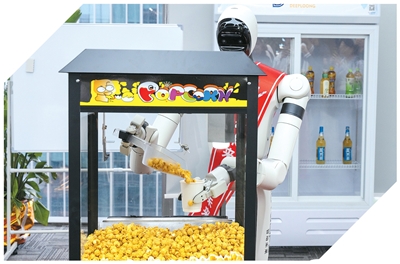
At Guangdong Intelligent Future Technology Co., Ltd. in Haizhu District, Guangzhou, Guangdong Province, a robot demonstrates selling popcorn. Photo by Xinhua reporter Liu Mengqi.
In a convenience store, reporters bought grilled sausages from a robot in English. On the street, they tried driverless cars. On campus, they experienced AI-enabled education. After personally exploring the wide use of artificial intelligence in daily life in China, several foreign-media reporters reached a similar conclusion: in China, AI is not the future; it has already arrived.
As China fully implements its AI+ initiative, artificial intelligence is being integrated broadly and deeply into industries and sectors across the economy and society. It is entering households and empowering businesses at speed. This wave of development has drawn wide international attention. While visiting diverse AI application scenarios, foreign reporters have also tried to understand what has produced China’s speed in AI.
Practical Applications: AI Moves Into Production and Daily Life
China’s AI industry is entering a new stage, marked by a shift in focus from training to inference, from technology to application, and from potential returns to actual returns.
In the energy sector, AI helps optimize power generation, smart grids, and renewable-energy management, improving system efficiency and stability. In education, AI enables personalized learning, intelligent tutoring, and automated assessment. In urban development, AI optimizes transport and public services; nearly 70% of new cars are equipped with smart cockpits, and autonomous vehicles are gradually being promoted.
The European technology-news platform Digital Agenda recently reported that China has built an AI application ecosystem spanning multiple fields. According to the report, China’s AI technology is being deeply integrated into economic production, social development, public services, and many other areas, enabling innovative applications to be widely deployed.
The Spanish website Modaes has focused on AI’s use in China’s textile manufacturing industry. It reported that in 2025 China announced the full implementation of the AI+ initiative, meaning that AI would be integrated into textile manufacturing to maximize productivity. This, it said, will have far-reaching effects on the global fashion industry. By 2026, the fashion industry must recognize that its dependence on China is no longer only about labor, but increasingly about China’s innovative intelligence and technological infrastructure.
Today in China, AI is deeply integrated into many industries and everyday life. From factories to campuses, from shopping malls to communities, AI is no longer confined to precise algorithms inside laboratories.
Singapore’s Business Times cited a Morgan Stanley research report saying that China’s AI industry is entering a new stage. The stage is characterized by a development focus that is shifting from training to inference, from technology to application, and from potential returns to actual returns. It is dedicated to increasing speed, lowering costs, and achieving system-level integration, allowing AI to spread rapidly through the real economy. The report said that in this new stage, China is showing a new advantage: it is faster than anywhere else at scaling up, adapting to change, and commercializing AI.
Malaysia’s The Star said China’s AI products emphasize practical implementation and have reached a world-leading level in resource integration. Its open-source and sharing-based developer ecosystem has effectively promoted the rapid spread of technology at home and abroad, as well as applications in energy, transport, medical care, and other fields. The integrated development of AI will help transform and upgrade China’s technology, industrial development, and industrial applications.
Time magazine in the United States said China’s AI industry is showing vigorous growth. Data show that China has thousands of AI companies and ranks among the global leaders in the number of valid AI patents. The article noted that the Chinese government is strongly supporting AI development and has launched the AI+ initiative. By 2030, the plan is for AI to comprehensively empower high-quality development in China, for the penetration rate of applications such as next-generation intelligent terminals and agents to exceed 90%, and for the intelligent economy to become an important growth engine for China’s economy.
Broad Strengths: Core Momentum for Innovation
The rapid development of China’s AI technology ecosystem benefits from multiple factors: government policy guidance, legal and institutional safeguards, stronger corporate innovation capacity, and the joint participation of social forces.
Why are AI applications accelerating in China?
Kyle Chan, a researcher on Chinese technology at the Brookings Institution, said in an interview on a New York Times podcast that, in terms of AI development paths, China wants not only to have the best AI models but also to emphasize practical applications and real-world scenarios. By finding ways to make these models work and building a broad ecosystem, China is integrating them into more and more services. This is especially clear in robotics, where government and companies are jointly promoting the integration of technology into daily life. That is why, in China’s large cities, autonomous delivery robots can be seen handling parcel and food deliveries; service robots bring food to tables in restaurants; delivery robots provide room service in hotels; and, in addition to autonomous cars, drones are used for food delivery.
A German technology website analyzed that the rapid development of China’s AI technology ecosystem is due to multiple factors, including government policy guidance, legal-system guarantees, stronger corporate innovation capabilities, and the joint participation of social forces. Companies, universities, and startups cooperate to form a complete innovation chain. China also builds platforms for technology display, capital matchmaking, and international exchanges by hosting events such as the World Artificial Intelligence Conference, accelerating the flow of knowledge and the implementation of technology applications.
Fortune magazine in the United States said that against the backdrop of intensifying global AI competition, China is showing increasingly prominent comprehensive advantages.
In energy supply, China has relatively abundant power resources and lower costs, which is crucial for an AI industry that depends heavily on computing power and data-center operations. In manufacturing, China has a world-leading manufacturing system, and its complete industrial chains can support the rapid production and large-scale deployment of related equipment, shortening the cycle from research and development to application. In the open-source ecosystem, Chinese technology companies and developers have continued to invest in open-source models, algorithm frameworks, and other areas in recent years. Many technological achievements have been opened to the world, attracting broad developer participation, accelerating technological iteration, and expanding the international influence of China’s AI technology. In capital investment, China has maintained a high level of input, whether through government policy support or sustained corporate investment, providing stable resources for the development of the AI industry.
Newsweek in the United States noted that China’s research and development investment has continued to grow rapidly in recent years, while its team of top researchers has expanded, injecting core momentum into sustainable innovation. At the same time, a group of internationally competitive Chinese technology companies has not only made breakthroughs in AI, but also advanced across electric vehicles, intelligent manufacturing, and other tracks. They have formed close collaborative networks with universities and research institutions to jointly tackle key core technologies. At the policy level, China is also actively guiding the application and promotion of domestically developed technologies, providing valuable market support for multiple strategic industries.
Open Source and Openness: Lowering the Threshold for the AI Era
China’s AI development path is affecting the global industrial ecosystem. By providing efficient, open, and high-performing technological tools, China is lowering the threshold for all parties to enter the AI era.
Japan’s Nishinippon Shimbun reported that high-tech products such as AI, electric vehicles, and industrial robots have become core drivers of China’s export trade. The coordinated development of China’s AI and robotics technologies is moving from technological breakthroughs toward large-scale application, driving the development of the technology industry and economic growth. China has consistently promoted the integration of AI and robotics with an emphasis on self-reliance and strength, while applying AI at scale and commercially in key areas to promote the development of high-tech industries.
AI is a common asset of all humanity. The flourishing of AI in China is both a result of high-level scientific and technological self-reliance and a product of China’s consistent commitment to consultation, joint contribution, and shared benefits. China encourages open source and openness and promotes AI accessibility. It has also proposed the establishment of a World AI Cooperation Organization and released the AI+ International Cooperation Initiative, contributing Chinese proposals to global AI governance.
Reuters in the United Kingdom said the global influence of Chinese AI companies is gradually rising. Chinese companies’ work in open-source models has led their technologies to be adopted by more international developers and companies, and some multinational firms are even developing products directly on the basis of Chinese models. This trend shows that China’s AI is competitive not only technically, but is also beginning to play a practical role in the global industrial chain. By promoting technological openness and application implementation, China is accelerating its transformation from a follower into an important participant, and its AI development path is affecting the global industrial ecosystem.
An editorial in the British journal Nature said China’s proposal to establish a World AI Cooperation Organization is in the interests of all countries, and that governments, researchers, and relevant institutions around the world should actively participate. The article called on countries to work together to discuss AI safety guidelines and jointly plan ways to strengthen AI governance.
Russia’s Expert weekly website cited experts as saying that China does not treat AI as a trend-following product, but as a practical tool for factory production, medical services, logistics, transport, and public services. This is clearly reflected in China’s various planning documents. China’s development experience deserves attention. Some Russian management schools have already cooperated with Chinese business schools to organize in-depth study of Chinese companies’ practical experience in implementing AI.
Malaysia’s New Straits Times said China has provided a new path for everyone through open-source models: the path of public goods. Thanks to open-source model weights and open downloads, a university in Brazil or a financial institution in South Africa can run and use the models on servers in its own country. Uganda’s large language model Sunflower, launched last year, was developed based on China’s Qianwen model. It can not only provide agricultural guidance to farmers, but also help students translate learning materials into local dialects. The article said China’s AI development is not only a national success story, but also shows how China provides development momentum for the whole world. By offering efficient, open, and high-performing technological tools, China is lowering the threshold for all parties to enter the AI era.
Comments
Discussion is powered by Giscus (GitHub Discussions). Add
repo,repoID,category, andcategoryIDunder[params.comments.giscus]inhugo.tomlusing the values from the Giscus setup tool.