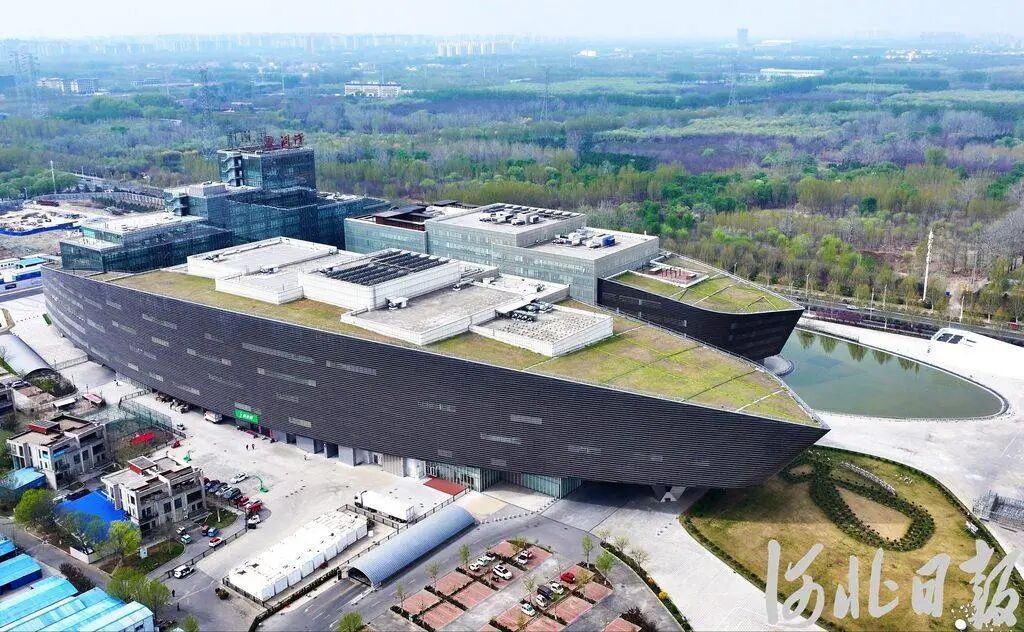
Drone footage of the Langfang City Big Data Innovation Application Center in the Beijing-Tianjin-Hebei region.
Recently, the “14th Five-Year Plan for National Economic and Social Development of Hebei Province” was released, which emphasizes the need to advance the construction of a digital Hebei and enhance the level of intelligent development. The plan aims to leverage Hebei’s computing power and scene advantages, activate the potential of data elements, accelerate innovation in artificial intelligence and other intelligent technologies, and deepen the expansion of “AI +” to empower economic and social development as well as governance capabilities, ultimately building a data-driven and intelligent digital Hebei.
This reflects Hebei’s strategic determination to actively embrace the trend of intelligent transformation and accelerate the cultivation of new productive forces. According to Chen Gang, an assistant researcher at Tsinghua University, the digital economy is no longer an optional question but a mandatory one. Advancing the construction of a digital Hebei will bring comprehensive opportunities for industrial upgrading, innovation breakthroughs, governance efficiency, and improvements in people’s livelihoods, becoming a strong intelligent engine for high-quality development.
Promoting Efficient Supply of Computing Power, Algorithms, and Data
Computing power, algorithms, and data are the three essential elements for the development of artificial intelligence. The plan outlines a clear path for the digital transformation during the 14th Five-Year period by promoting the efficient supply of computing power, algorithms, and data.
During the 13th Five-Year period, Hebei focused on building a nationally leading computing power industry ecosystem, with the province’s comprehensive computing power index ranking first in the country for two consecutive years. Langfang and Zhangjiakou have consistently ranked among the top two cities in computing power index.
The plan emphasizes strengthening the construction of computing power infrastructure. During the 14th Five-Year period, Hebei will accelerate the establishment of a national integrated computing power network hub in the Beijing-Tianjin-Hebei region, promoting the creation of an integrated computing power network and establishing a shared computing power resource pool. The construction of the Zhangjiakou-Langfang intelligent computing power supply corridor will create an intelligent computing power aggregation area around Beijing.
According to Xia Luohui, director of the Hebei Institute of Technology Innovation at the China Academy of Information and Communications Technology, this integrated layout aims to address the previous issues of dispersed computing power platforms and inconsistent standards. Hebei will shift from “single-point breakthroughs” to a “one network for Beijing-Tianjin-Hebei” approach, transforming green electricity advantages into cost advantages through interconnected computing power resource pools and collaborative mechanisms.
To promote the iterative innovation of algorithm models, Hebei will implement a major model research and development initiative, aiming to cultivate a batch of high-level vertical models in various industries and create replicable and promotable industry-specific model demonstrations. Collaborative models such as “Jing Model, Ji Training” and “Ji Training, Jing Use” will be explored to iteratively upgrade vertical models in steel, automotive parts, cultural tourism, and government affairs, supporting the application of large models in industries like chemicals, construction materials, education, and healthcare.
Focusing on deepening the development and utilization of data resources, Hebei will expand the supply of public data resources during the 14th Five-Year period, encouraging enterprises to circulate data through various means such as sharing, trading, and resource replacement, and to build high-quality data sets. The province will carry out the “Data Element*” initiative and steadily advance the construction of data infrastructure. Additionally, it will promote the development of data industry clusters in cities like Shijiazhuang, Zhangjiakou, Langfang, and Baoding, and support the establishment of a national data labeling base in Baoding, creating a data labeling industrial belt around Beijing.
With a strong computing power “engine,” efficient algorithm “brain,” and smooth-flowing data “blood,” Hebei is advancing the integrated development of computing power, algorithms, and data, constructing a full chain of “computing power supply - algorithm innovation - data empowerment,” forming an important support for the development of the digital economy.
Empowering Industries with Intelligent Technology
Artificial intelligence is becoming a powerful driver for high-quality economic development. The plan focuses on empowering industrial development through intelligent technology, proposing the implementation of the “AI +” initiative to enhance the deep integration of the real economy and the digital economy, and to strengthen and expand the digital economy.
“AI +” is not just a simple addition but a deep integration. According to Zhuang Zhiwei, director of the Development and Planning Department of the Provincial Data and Government Service Bureau, Hebei possesses a complete industrial system and a vast array of application scenarios, which provides confidence for intelligent transformation. In the next five years, Hebei will accelerate the digital transformation of the economy driven by the “AI +” initiative, seizing the high ground of AI industrial applications and empowering various industries comprehensively.
According to the plan, Hebei will expand the space for economic digital transformation, strengthen core industries of the digital economy, promote the intelligent transformation and digital networking of manufacturing, advance the digitalization of the service industry, and develop smart agriculture. Each measure is precisely targeted to comprehensively empower industrial upgrades.
“AI +” not only aids industries in advancing but also opens up new ways of living.
The plan states that Hebei will fully leverage intelligent technology and data elements to enrich people’s lives and improve their well-being, promoting the integrated application of AI in education, healthcare, elderly care, employment, culture, and consumption.
The implementation of smart education demonstration projects, digital healthcare demonstration projects, and the vigorous development of digital cultural and creative services will enrich scenarios for smart homes, smart travel, and smart communities. In the next five years, AI will integrate into daily life with unprecedented depth and warmth, becoming a force that enhances quality of life and serves the public.
The digital transformation of government services is also accelerating. According to the plan, Hebei will deepen the full-process application of intelligent technology, developing diversified government services that are accessible, smart, convenient, and equitable. This includes enhancing the digital and intelligent governance and service levels of government, exploring the construction of a service model that accurately identifies needs, proactively plans services, and processes them intelligently throughout, optimizing platforms like “Ji Time Service”.
Zhuang Zhiwei noted that this signifies a profound shift in government services from “people seeking services” to “services seeking people.” In the future, high-frequency matters such as business registration and project approval will be handled through large models for intelligent form filling, automatic verification, and instant processing.
Balancing Development and Governance for a Healthy Digital Economy
The healthy development of the digital economy relies on scientific and effective governance. The plan emphasizes the importance of balancing development and governance, advancing the foundational system for data elements, and ensuring a beneficial, safe, and fair development environment.
“Data only has value when it circulates. The deployment in the plan regarding the implementation of foundational systems for data elements is key to transforming data resources into assets,” said Chen Gang.
He believes that as a new type of production factor, the core breakthrough for data elements lies in resolving challenges related to rights confirmation, pricing, and circulation. This year, Hebei achieved two major breakthroughs: the first batch of data property registrations in the country and the first case of data asset pledge financing, marking a milestone in the market-oriented reform of data elements in Hebei, clearing obstacles for the conversion and circulation of enterprise data.
During the 14th Five-Year period, Hebei will implement systems for data property rights, circulation and trading, revenue distribution, and safety governance, effectively utilizing data pricing mechanisms, cultivating a service ecosystem for data element circulation and trading, and promoting the inclusion and valuation of data assets, forming a comprehensive service system of “data rights confirmation - valuation - inclusion - pledge - securitization.”
As technology advances, regulatory mechanisms are increasingly needed for protection.
During the 14th Five-Year period, Hebei will strengthen safety regulation for new technologies and new business models, improve AI governance, promote innovation and healthy development of the platform economy, and legally combat data abuse, forgery, and privacy breaches. It will explore cross-business and cross-departmental joint regulation in various scenarios, constructing a multi-faceted collaborative governance ecosystem.
“Governance is not a decelerator but a stabilizer and safety net,” said Shao Yunxia, a researcher at the Hebei Academy of Sciences. As technology continues to innovate and break through, relevant parties are accelerating the formulation and improvement of laws, regulations, policies, application norms, and ethical guidelines, which will clarify the direction, leave room for growth, and lay a solid foundation for the healthy development of artificial intelligence.
Comments
Discussion is powered by Giscus (GitHub Discussions). Add
repo,repoID,category, andcategoryIDunder[params.comments.giscus]inhugo.tomlusing the values from the Giscus setup tool.